

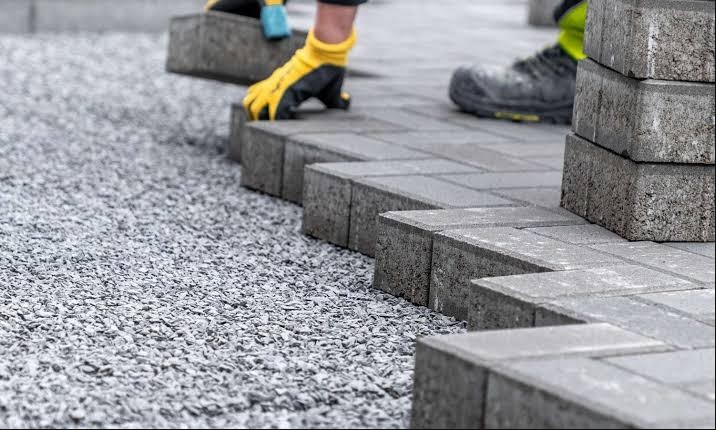
You could walk across a finished driveway and not have any idea what was going on under it. But that buried layer is the major reason some Paving Cork jobs withstand decades while others start sinking in two winters.
Most people only look at the surface, the color, the pattern, the finish. Okay, fair enough. That is the part that you see every day. But it is the sub-base under any Paving Cork surface that takes the weight of vehicles, fights frost heave, and keeps everything resting level year after year. Skip proper attention here, and no number of attractive blocks on top will save the job.
Why You Can’t Opt Out of Deep Digging
A driveway has to accommodate a car parked on it every day, often two. This is done by excavating the existing ground to the required depth and then replacing it with layers of compacted stone, built up in stages rather than dropped in one go.
A patio that is only for foot traffic doesn’t need to be as deep as a driveway. This differentiation is one of the more prevalent shortcuts performed on hurried Paving Cork operations.
Things to Verify Before the Work Begins
- What is the anticipated depth of excavation for your specific area, driveway vs. patio?
- Has the existing soil type been examined, as clay responds quite differently to sandy soil?
- How many layers of sub-base material will be placed, and will each layer be compacted individually?
- What’s the fate of tree roots or old foundations if they’re exposed mid-dig?
The Invisible Compaction Step
Here’s the bit that really separates a job that lasts from one that fails. Every layer of stone must be mechanically compacted before the next layer is placed on top, not just at the very end.
If intermediate compaction is skipped, hidden spaces remain that slowly settle under the weight of cars, appearing months later as dips, fissures, or uneven joints across the surface.
Many homeowners in Cork only come to know about this step when something has gone wrong, and that’s a shame because it’s an easy one to ask about beforehand. Simply asking whether each layer is compacted separately tells you a lot about how seriously a contractor approaches the unseen aspect of Paving Cork work.
How the Sub-Base Controls Drainage
The sub-base not only provides strength but also creates the gradient that determines where rainwater will travel.
A 1% to 2% slope away from the house, built into the stone layers before the surface is installed, helps direct water toward drains instead of allowing it to collect near the entrance. Get this wrong at the base level, and there is no simple fix without lifting the entire surface later.
A Simple Method for Evaluating the Work
Be sure to ask to see the site during the project, especially after excavation and before the surface finish is installed.
A contractor who believes in their Paving Cork method will be happy to show you the compacted layers and explain the build-up. If they appear reluctant to let you inspect the work or rush through that phase, pay close attention.
Conclusion
It’s not rocket science. It requires patience, proper layering, and careful attention to a part of the job that becomes invisible once it’s finished. That is precisely why the sub-base deserves the most attention before any Paving Cork project begins.

